Parents who want to teach their children programming have a lot of possibilities, from the simplest programming tools to full-fledged classes in the classroom, but the new system called SAM offers another, no less interesting solution.
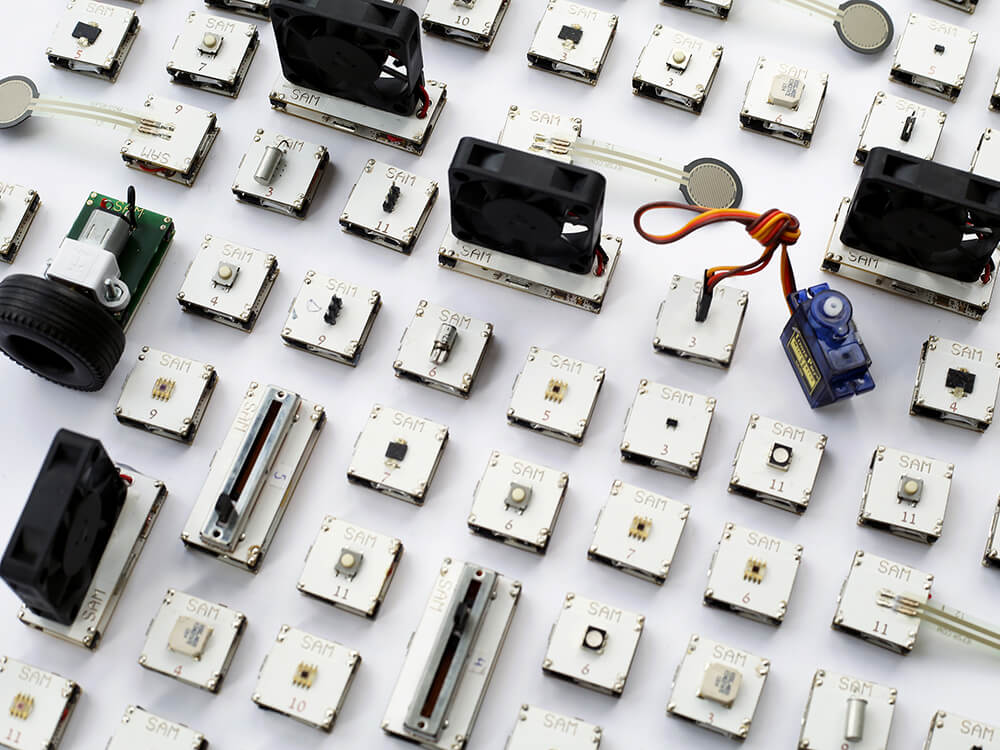
SAM is a series of postage stamp sized sensors and actuators that combine software and hardware and promise access to the Internet of Things without the need to know circuit design or have programming experience.
SAM modules are autonomous and do not require a soldering iron, they are equipped with their own power supply and wireless radio, which can communicate with the base of a personal computer at a distance of up to 45 meters. Programs for them use an interface like drag-and-drop, and each lightweight element of just a square inch in area and a quarter of an inch thick can be an unobtrusive addition to almost any project.
The current composition of the modules includes eight elements of input, including buttons and levers, motion sensors, light and temperature; as well as five outputs, including motors and light bulbs. Despite the limited options palette, users can create very interesting products in combination. An 8-year-old boy built a machine capable of skirting obstacles using a proximity sensor and several motors.
“It was very cool, and I even wondered why I received an engineering degree,” said SAM creator Joachim Horn.
Another student built Twerk-Bot, after watching Miley Cyrus, who was moving to the music. The rest of the young creators make more traditional musical instruments and toys, but the common leitmotif is to pay more attention to their creative goals, and not to bother with the manufacture of elements.
“It’s very important when a non-techie gets his hands on electronics and immediately understands what it is intended for and how to use it,” says Horn.
Inspired by the products
London-based creator Joachim Horn began working on the project when he was in graduate school, where he gathered a multinational team of 67 designers and innovators to hone his system through a series of seminars, hackathons and exhibitions.
“My dream has always been to be part of a multidisciplinary team of like-minded people at the age of twenty who would get more pleasure from working together than watching a football game.”
The result of this collaboration was a fresh look at electronics, which was focused on eliminating discouraging frustration associated with working with electronics.
“I’m a mechanical engineer and I’m always afraid of the dark magic of electrical engineering,” says Horn. “If you are lucky and you do everything step by step, point by point, and grace descends on you, then everything will work and you will feel relieved.”
DNA design
Horn believes that the value of SAM lies not in the technical specifications, but in the very philosophy of assembling modules. Unlike Lego Mindstorms, which is aimed at people who want to create functional, but very aggressive looking robots, SAM is a neutral solution for creatives and designers. The capabilities of the modules allow you to throw out the workbench and make nice indoor things.
SAM was created as a tool for learning for children and developing their engineering skills, but in fact the system can help users of all ages learn how to easily and easily create interesting projects without having to know the subtleties. SAM applications include several features: viewing code for advanced people who want to dig in it, and for mere mortals who just want to do something.
“Creative designers, startups and independent developers will be able to compete with large companies in the field of“ smart objects ”. Innovations will come from the best ideas and best specialists, and not just from those who can afford a costly startup and waste money. ”
Cost vs. Value
SAM is a sensible solution, but its cost may be debatable. Given the rechargeable batteries and wireless connections in each brick, you can guess that each module will cost about $ 25. Compared to LittleBits, which start at $ 9 per item, and the Raspberry Pi, which costs $ 35, or even a $ 150 Nano kit, the SAM system can be very expensive.
Although the SAM price itself is quite expensive, each module is equivalent to at least four LittleBits, and Horn notes that their reuse provides even greater value. SAM modules can be implemented in different classes, ideas, projects, delete, replace and improve.
The Kickstarter project overcame the necessary fees barrier and will work on October 29 with an expected launch in March 2015.
The article is based on materials .
Comments
Post a Comment