
In 2011, the British professor Harald Haas introduced the world the concept of a completely new technology for wireless data transmission using LEDs. It was then that the term "Li-Fi" came into being, consonant with the usual Wi-Fi. At that time, many considered the idea of the professor to be just a "cool concept", which would never find practical application in our life. However, four years later, Harald Haas created the first working prototype of a Li-Fi router.
If you think about it, this way of going online can make a small revolution in the world of wireless technologies. After all, data transmission using LEDs located inside fluorescent lamps is much faster than Wi-Fi, and is also protected from interception of data, unless the person is in the same room with the transmitter and receiver. It's no longer possible to intercept data from the next room or from the street from intruders.
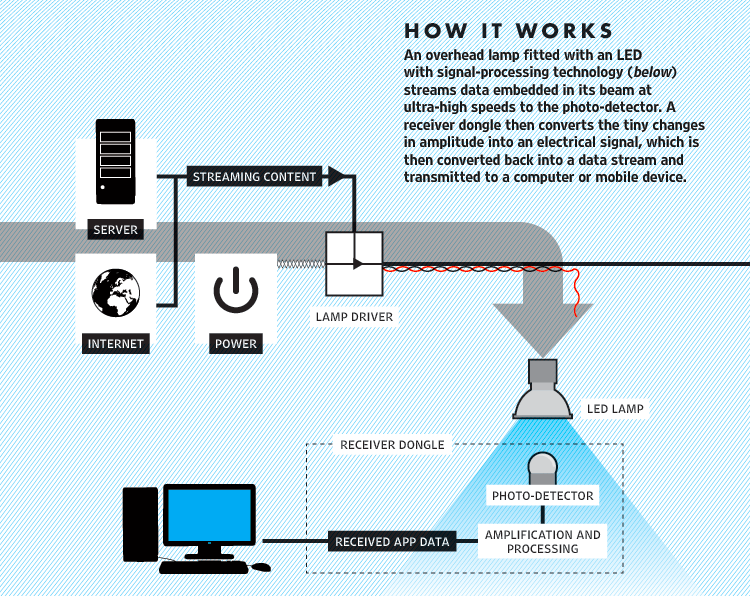
Not only Professor Haas is involved in research in this field. In 2011, German scientists recorded a speed of LED data transfer of 100 MB / s at a distance of 1.8 meters in the laboratory, and Chinese engineers set up the output of four computers to the network using a 1-watt LED light bulb. Own company of the professor sees a great future in this technology. It will allow the introduction of wireless light communication in smart homes, custom gadgets and the Internet of things.
The first prototype of the professor's Li-Fi router is powered by a solar battery. In fact, we get a secure source of a stable Internet connection, which is completely autonomous in terms of power consumption. To transmit data, the router does not use cables or radio waves, instead it transmits data with an almost imperceptible flicker of LEDs. The advantage of this technology is primarily in low power consumption, because the efficiency of conventional routers does not exceed 5%, since most of their energy goes into heat. The maximum data transfer rate with Li-Fi is 10 Gbit / s.

Professor Haas is currently looking for partners who can help him bring promising technology to the market. Meanwhile, other companies are trying to popularize Li-Fi, including Russian ones. For example, the domestic company Stins Coman is working on a wireless Li-Fi network called BeamCaster, which will be capable of transmitting up to 5 gigabytes of information per second.
The article is based on materials .
Comments
Post a Comment