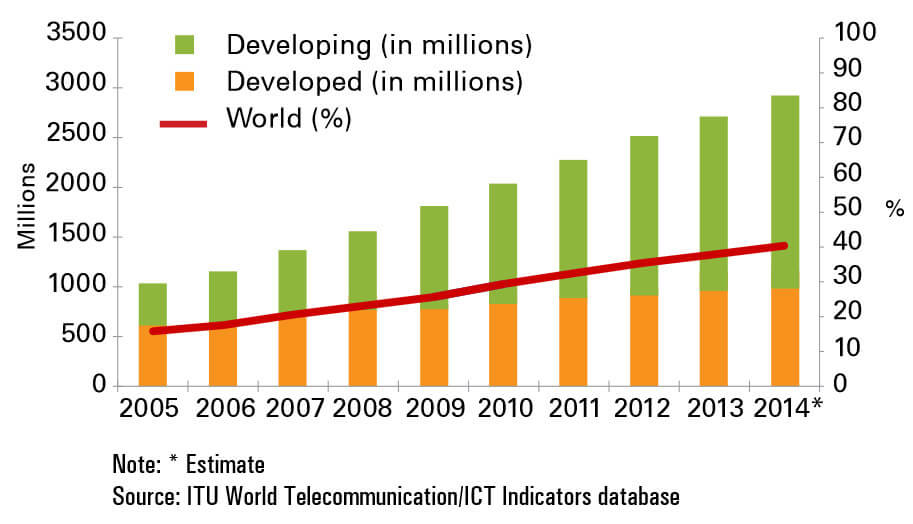
It would seem that this is surprising, but just think: as early as next year, a three billion billion user will visit the world wide web. Some 10-15 years ago, the Internet was for some of us something fantastic, but today it is used by almost every person with average incomes.
Specialists of the International Telecommunications Union (ITU) company predict that the three billionth user of the global network will go online in the first weeks of 2015. This company for many years conducts a thorough analysis and accounting of attendance of the Internet, as well as user activity in various countries of the world.
The ITU company assumes that, most likely, the three billionth lucky will be a citizen of a third world country, since this is where the most active expansion and development of the mobile Internet is going. Third world countries are now conquering the Internet much more actively than economically developed countries, which, in principle, not surprising.
It turned out to be interesting and about the speed of Internet access in various countries of the world. South Korea ranked first in terms of access speed to the worldwide network, 35% of users of which have Internet access speeds of 10 Mbit / s and higher. In Russia, this figure is much lower. In our country, only 4% of Internet users can boast speeds of 10 Mbit / s or more. And all among the inhabitants of our country about 15% of the population are connected to the world wide web.
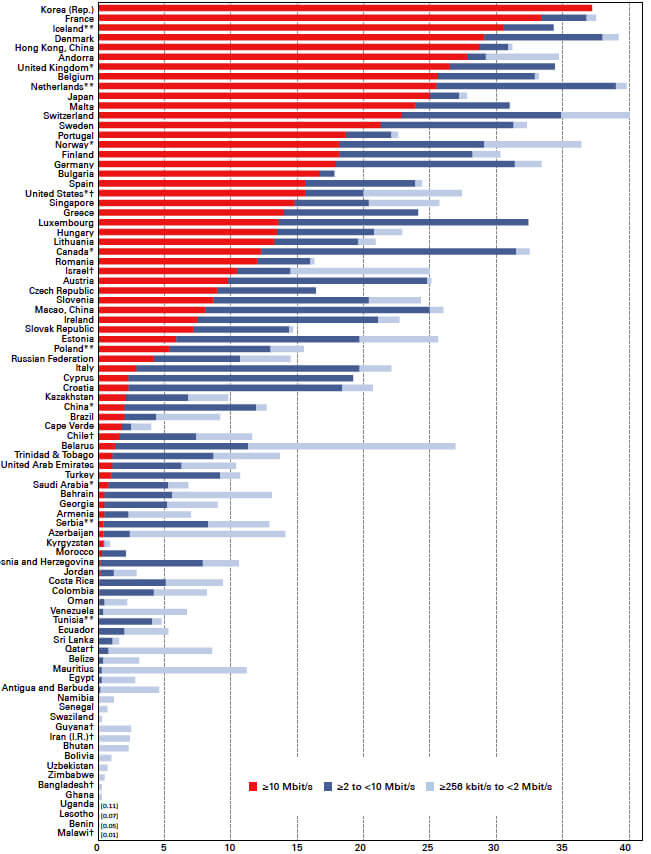
In addition to South Korea, residents of France, Iceland, Denmark, China, the UK and other countries can boast of high-speed Internet. If you are interested, the United States is not included in the top ten charts, and takes only 20th place. In the United States, approximately 27% of citizens have access to the Internet, and only 15% of users can boast a connection speed higher than 10 Mbit / s.
Be that as it may, the Internet is sweeping the planet by leaps and bounds. And if we literally used telephone modems just a few years ago, today we are not satisfied with the 100-megabit channel. In the next few years, there may be a revolution in the transfer of information, and we will begin to exchange it at speeds that we didn’t dare to think about before.
The article is based on materials .
Comments
Post a Comment