
Google. How much in this word was found for our heart. Remembering this company, you first need to remember the notorious search system, which is used by billions of people. Considering that Google accounts for about 70% of all Internet searches (or about 85% of the English-speaking world), this is not surprising. In the end, the search engine Google is so well known that the company even deserved a place in the dictionary of everyday speech. All googling Google in Yandex and Yahoo. As a thermos, cellophane and copier have become common words for us, so Google.
You may be surprised, but Google has other products, such as Maps, Google+ or Blogger, but they are not significant in the general scheme compared to the search. Yes, Gmail and Android are very important products, but let's be honest, even hundreds of millions of Android users are nothing compared to the target audience of the Google search engine. Loss of Gmail will cause a burning lower back, but we will find an alternative. But if Google search disappears, it will be much more painful. I think it would not be an exaggeration to say that the society as we know it will drastically change without the Google search engine.
It is a little scary to realize that a single service has such an influence. The phrase "do not put all your eggs in one basket" comes to mind. In many ways, just as we have several reservoirs, power plants, hospitals and schools, we would need to get another viable search engine. After all, if Google wants, tomorrow the company may disable the search.
But - and now we get to the point - although the search engine remains an important part of our life, it is almost the same person is the key to success and the fall of Google. Without a search engine, Google would fire most of its workforce or lose billions of dollars a year. At the end of 2013, 91% of Google’s revenue was derived from advertising, most of which is related to paid ads in search results. The remaining 9 percent comes from a mix of sources, mostly Google Apps (corporate versions of Gmail and Docs / Drive). All the rest - Android, Gmail, Docs, Blogger, Maps and others - this is the icing on the cake. Gaining 91% of the income from a single source is an extremely dangerous thing. Despite the Bombing profits, Google walks the blade of a knife. The online advertising marketplace will not exist forever. A search engine company needs to do something quickly.
Diversification
To put one word on what Google needs to do is diversification. Companies need to develop new sources of income, ideally not related to advertising. It is easy to see that almost all of Google’s web-based resources (except Apps) make money from displaying ads that are managed by AdSense and DoubleClick (and yes, both are Google’s). Google Apps selling monthly subscriptions to the business versions of Gmail, Docs, Calendar and Drive is a good start, but the company needs more.
So that you understand the scale of the problem, let me give you a few numbers. Google’s revenue last quarter was $ 14.9 billion. 91% of them, that is 12.54 billion, were obtained from advertising. Another $ 1.23 billion goes to "the rest of Google’s revenue," mostly from Google Aps subscriptions. Android, despite the shipped 200 million smartphones in 2013, brings a penny. By the end of 2012, according to various estimates, Google had gained only $ 550 million from Android devices and almost 2 billion from iOS devices. These numbers have changed significantly in 2013, but the fact remains that Android does not make big money.
Of course, this does not mean that Google is not trying to diversify. In fact, Google is famous for its famous “let's do and see what happens” approach, which resulted in the company managing a set of free products and services. Virtually none of this gives money, and the content requires large investments. After Larry Page became the CEO in 2011, many services shut down.
Where does this lead Google?
Of course robots
Google has never been afraid to use its huge cash reserves (according to various estimates - within $ 60 billion) to purchase new products and personnel. DoubleClick and AdMob, two big cash cows, cost Google a lot of money (3.1 billion and 750 million dollars, respectively). YouTube was acquired for 1.65 billion dollars. Motorola Mobility cost $ 12.5 billion (but as time shows, it was more a patent than a device manufacturer).
Historically, however, almost all of these acquisitions have reinforced Google’s major acquisitions (search, advertising, maps, mobile). Over the past year, the habit of buying Google has seen a change. Google still maintains its core services, but also began to acquire companies and talents, which at best are tangential to the core strategy.
The most notable of these acquisitions was Nest Labs, a small manufacturer of thermostats Nest and smoke detector Protect. Buying cost $ 3.2 billion. As it is easy to understand, this is the second of the most expensive acquisitions of the search giant. In December 2013, Google took eight leading companies in the field of robotics, including Boston Dynamics, with which the amount of the deal was not disclosed. Back in May 2013, Google bought Makani Power, a startup developing an onboard wind turbine that generates electricity. It is also not clear how much. Google has also acquired two major startups involved in the development of artificial intelligence: DNNresearch and DeepMind ($ 500 million), their appointment remains behind the veil of secrecy.
This leads us straight to Google X. Almost all of Google’s recent acquisitions have been stacked in Google X, where a team of innovators and entrepreneurs, led by Google co-founder Sergey Brin, are working. He will turn the new technology and talent into money. Google X is a secret facility located about a kilometer away from Google’s main campus, where science fiction technologies are being developed, which, in turn, will be turned into commercial products and solutions. The most famous projects to date are self-driving cars, Google Glass, and smart diabetic contact lenses that can measure blood sugar levels in the eye. They say Google X is working on hundreds of projects that practically do not overlap with the main course of the company. In short, Google X is hunting for the next billion dollar Google business. The question is, what will it be?
The future of Google is not a search
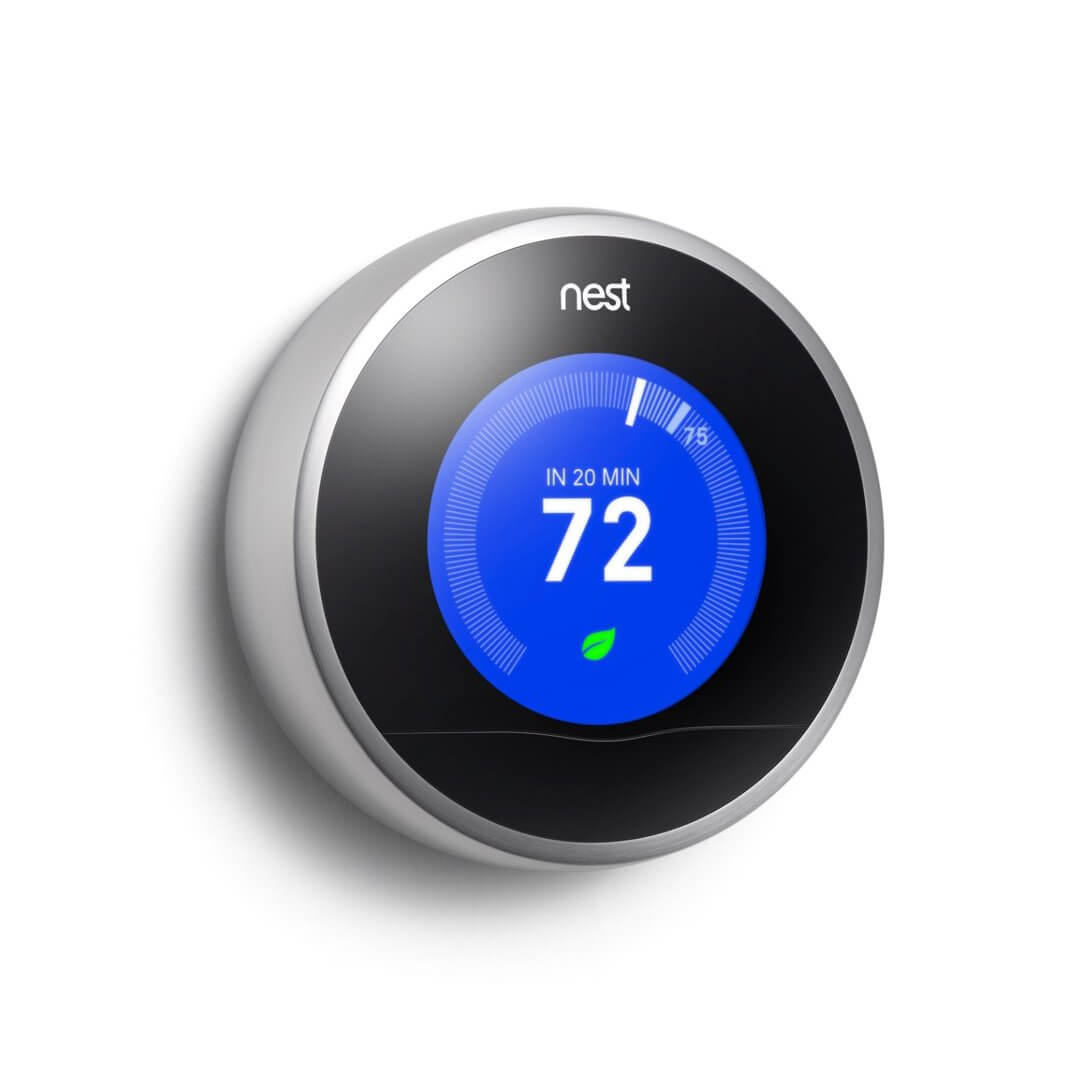
Although Google has a lot of cash, $ 3.2 billion laid out for Nest is a very large amount. Google will probably not lose sleep if one of the small acquisitions (from 50 to 500 million dollars) is to be written off, but Nest is a big acquisition. The home automation brand Nest is definitely what the company is interested in. Likewise, if you buy the eight largest robots, you become the world leader in this arena. Google definitely hints that gugloboty will appear soon. We can ignore the small acquisitions of Google (although considering how much energy is consumed by the company's data centers, no one would be surprised if it enters the segment of cheap energy).
And while you can definitely benefit from selling smart home appliances, Google is interested in Nest’s ability to collect a wealth of information. Some believe that Google’s strength is handling large amounts of data and turning them into valuable services. Imagine if every home is equipped with a Nest thermostat that sends information back to Google. If a company can process this data, in particular, how we heat our homes, it will earn billions to the right companies.
It would be naive to believe that Google is only interested in Nest thermostats and smoke detectors. Surely Nest is working on other solutions that will turn the stupid devices in your home into smart ones. Perhaps there will be some energy node Nest, to which other devices will be connected. They will tell you how much energy your house spends, so you can pay close attention to it. The scope of the Nest solutions only seems incomprehensible.
With this kind of data, Google will know almost everything about our life, which will allow it to easily convert it into money through the sale of advertising or the sale of information.
In addition, let's not forget about robots. There are two different ways Google can go. Easy and proven way - industrial robots. Those that collect machines and devices, run around the Martian valleys, crash against walls at high speeds, automatically serve data centers, and so on. Difficult way - consumer robotics. A robot servant who meets you at home and asks if you can help you with anything. This will be a completely new and unusual segment, which, however, is extremely risky. In this case, Nest and other home-comfort companies can significantly help the future guglobs.
In the future, Google will not only become the ruler of the online world, but will also live in your home - and, of course, soon and in the workplace. If Google can make a lot of money, being omnipresent in the virtual space, imagine what would happen if Google deals with your home, office and car. You wake up, check your Google Now, the guglobot is already carrying you slippers and a suit. You dress, go down the stairs and breathe the air conditioned by Nest, since your wife nagulila the day before that it will be hot. Guglobot tells the important news of the day while you are having breakfast. At the gate is already waiting for Google's self-driving car, which will take you to work.
Here is the answer to the question in the headline: and this is a search giant? So far, yes, but a lot can change in the next few years. If you have not noticed, Google already occupies an important place in your life. Very soon it will not only search. And we will continue to feed the company, because it will be impossible to resist the machines that it offers us in the future.
The article is based on materials .
Comments
Post a Comment