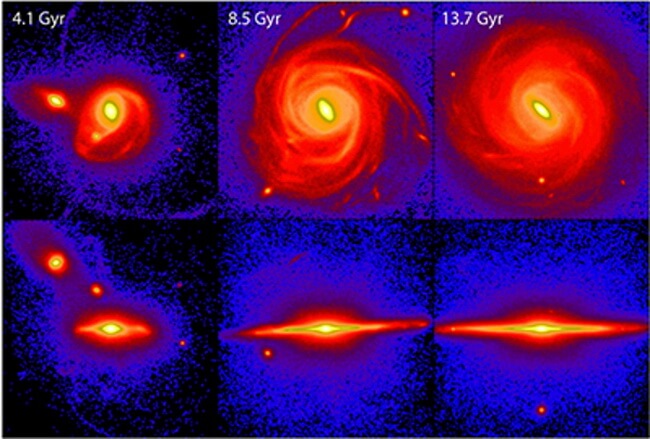
Using modern modeling techniques and data collected from studying several stars nearby the Sun, a group of astronomers was able to reconstruct, in their opinion, a more accurate model of the evolution of our Milky Way galaxy.
This research was led by Ivan Minchev from the Potsdam Astrophysical Institute in Leibniz. For this work, the team decided to focus on analyzing the vertical motion of stars perpendicularly located to the plane of the galaxy disk. Scientists measured how this movement correlates with the age of each individual star. And instead of analyzing the age of each star, scientists used their chemical composition as an indicator.
The simplest indicator in this case was the ratio of magnesium and iron in these objects. Data on this composition was obtained in the framework of the RAdial Velocity Experiment (RAVE) program using the Schmidt telescope located in the Astronomical Observatory of Australia and engaged in the study of the stars closest to our Sun.
The group found that stars with a high ratio of iron and magnesium did not have faster vertical motion, as some of the theories suggest. It is possible that the higher volume of these elements was due to the lower speed of the star. The computer simulation model of the Milky Way, on the basis of which a team of scientists tried to explain the results of their research, showed that dwarf galaxies with which our own galaxy could collide at some point in its history could be the cause of this phenomenon.
The result of these collisions, according to the computer model, was another very interesting effect. Due to these collisions, the Milky Way appeared spiral arms, and a huge number of stars moved from the galactic center to the outer galactic ring. Experts believe that at this moment the entire galaxy experienced tremendous vibration emissions.
Based on the vertical speed of the stars, researchers from the Potsdam Astrophysical Institute were able to determine that the Milky Way could collide with a much larger number of dwarf galaxies, as previous research and theories suggest.
“Our results allow us to more accurately follow the history of our own galaxy. Having determined the chemical composition of the stars that surround us, as well as tracing how fast they move, we can understand the properties of dwarf galaxies that have encountered the Milky Way throughout its history, ”says Minchev.
“This study is very likely to be able to lead all of us to a better understanding of how the Milky Way has evolved into the galaxy that we can observe now,” the expert concludes.
Full details of the study were published in the Astrophysical Journal Letters on January 20, 2014.
The article is based on materials .
Comments
Post a Comment