
If you closely follow our site, most likely you managed to see an incredibly realistic portrait of Morgan Freeman, drawn entirely in the Procreate app for iPad. The portrait is so identical to the photo from which it was drawn that many of you could not believe your eyes. Is there any reason to doubt the honesty of the creators of the picture? Or was the artist unfairly criticized for doing everything too well? Resource Gizmodo gathered a few facts that will help us figure it out.
Act One: Deep Penetration
A quick glance at the Kyle Lambert site to see that he is a truly talented artist. His work includes cartoon sketches and photorealism. More than 50,000 people have subscribed to his YouTube channel, and his works regularly delight painting lovers on Apple technology.
However, from all that he did, nothing compares to the portrait of Morgan Freeman in terms of quality and popularity. According to Lambert, it took him about 285,000 brush strokes and more than 200 hours of hard work to create a masterpiece. This is also the first major work that he downloaded via Procreate. In this regard, the artist says, the result, of course, looks different than his other works.
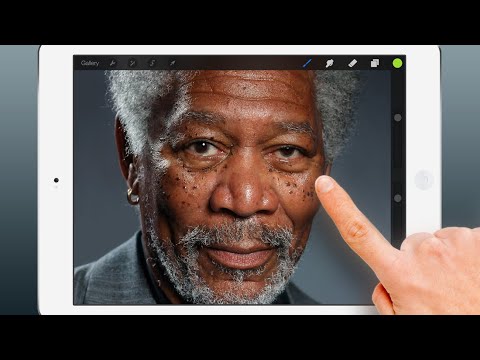
As soon as Lambert downloaded the video, the Internet went crazy. For a month, the YouTube video was viewed over 11 million times. And as it usually happens, behind the popularity came a wave of criticism.
Main claim: the picture is too hyper-realistic. The photo Lambert used as a source of inspiration quickly surfaced. People began to accuse Lambert of fraud, citing the inability to track down many of the ways that Lambert used in the drawing process. Despite this, Lambert remained neutral.
Should we believe?
Second step: on the hook
The first complex allegations of fake came from the site of Sebastian's Drawings. Three days after the release of the video, Sebastian noted that when placing the original photo of Morgan Freeman over the drawing, each drawing pixel fits perfectly with the original. Only one conclusion:
“The only acceptable option is if you took a photo, painted over it, eroded the details, and then reversed the video.”
In fact, the ratio of the drawings shows that this is quite possible. To silence the skeptics, Procreate decided to conduct its own investigation. Lambert is one of the beta testers of the application, so it would be very bad to approve of his work if it is illegitimate.
Lambert readily agreed to help the company carry out the investigation, and experts began to look at the baseline data to identify fraud. Here is what the source told Procreate James Cada:
“Look, Procreate records every step. Each action is saved to a file as soon as the user moves his finger away from the screen. Actions are saved every 1/30 second in two buffers. The first is responsible for the layers, and the second for the video. It turns out, one action - one frame of video.
Over time, these frames create a video file. When Procreate is minimized, the video buffer closes and creates a video segment. Over the days in the process of drawing sequential video segments are created inside the .procreate file. When a user exports a video, Procreate merges the video segments into one file. ”
In other words, Procreate oversees the process. If the drawing were false, the file could be immediately determined.
As it turned out, the .procreate file presented by Lambert contained all the successive video segments. The company presented a screenshot as an example of what they were looking for.

In addition, Procreate successfully exported videos using files inside the application. The result was a 2-hour video that “clearly showed that he actually worked for 200 hours without importing images.”
That's all. Problem solved? Not.
Act Three: Unforgiven
Gizmodo sent Procreate Screenshot to Brian Macfili, a programmer working in the field of distributed systems and API development. He immediately hacked the screenshot. Macfili showed how using simple code in a Mac terminal can recreate the same effect without doing any work after the fact.

And although it may seem ridiculous that the company will go for it to justify a lie, the screenshot does not provide convincing evidence.
There are other problems. Hardcore skeptics reached the FotoForensics photo data analysis site in the hope of completing these negotiations. Sebastian, about whom we spoke above, wrote that the result of drawing includes the same ID as the original picture of Morgan Freeman, made by Scott Gries, which suggests that the photo was inserted into the document at some point.
It may not matter, but the presence of a photo layer will seriously reduce the chances of Lambert to justify. And this also contradicts what Lambert said about his work process:
“The original photo was not on any stage of drawing either on the iPad or in the Procreate application. Procreate documents the entire drawing process, so if I wanted to import a photo layer, it would be shown in the video. ”
The problem is that FotoForensics showed that the image was “completely made on Photoshop CS5 and CS6 on Mac” and not on Procreate, as stated.

Attempting to prove that someone is lying can bring a lot of problems, but Sebastian notes that the meaning of his mission is only to distinguish a digital trick that reduces the artist’s achievements from genuine mastery. This is true. And it would be fair even if Lambert really turned out to be a charlatan.
But as it turned out, it was not.
Act Four: Glory
It is easy to forget that the Morgan Freeman picture, floating on the Internet, is not the original. This is a tightly compressed print version of the original, which weighs 4096 by 3072 pixels. To see what the artist worked with, the Procreate team compared the full pictures in all their multi-pixel fame:
“We exported the PNG file in Procreate's native resolution, opened it in Photoshop and superimposed the original photo of Scott Grise. Looking at the images in full resolution, we found that the proportions and colors do not match perfectly. When zooming in, it is easy to detect obvious brush strokes and imperfections. Contrary to the charges, it is obvious that the artist’s work does not match the original pixel to pixel. ”
But what about the FotoForensics data, which shows that the image never happened inside the iPad? Procreate gives a very logical explanation for this:
“These guys used .jpg from the Internet, not the source file. Unfortunately, any attempt to prove a lie using an image from the web will result in failure.
The original work of Procreate has a resolution of 4096 by 3072 pixels, and a compressed image is 1000 by 740 pixels. They checked the image, reduced in Photoshop for the press (Procreate can not resize the image). When you resize the image and save it in Photoshop, the metadata will reflect the changes. Without the source file, working with FotoForensics will be meaningless. ”

Finally, XMP data shows at what point the photo of Scott Grise was copied into a compressed image. Kyle noted that in his Photoshop he “put the original photo in order to see how exactly” he managed to portray Freeman.
Important point: the original photo was copied in Photoshop over the final compressed image. Not in procreate. If Kyle had imported the original photo into Procreate, one would say that the work is amazing. The fact that the video data in the Procreate source file indicates that there was no import speaks only for the skill of this guy.
This argument has weak points - MacFili claimed that the Procreate workflow is described extremely intuitively, but they are softened by a simple fact: the company did a lot to examine whether the beta tester really lied. What is remarkable, when Macfili put Lambert’s drawing on the original photo, the similarities were not as obvious as Sebastian pointed out.
Facial hair is similar, but does not match a pixel to a pixel. This is quite possible to achieve, if you draw with a large increase and work with a tiny step, but hardly anyone has the patience to do it.
In other words, forging a picture is more difficult than drawing. In addition to the fact that the pictures do not match pixel by pixel, the lines in the figure look thicker and less transparent - this can only speak about working with a touch device. And although the work looks extremely tedious, in a conversation with Gizmodo, Lambert expresses pride in the time he spent drawing and the strength he put into it:
“I worked on it for a month. On the site, I wrote that it took about 200 hours, but there was a little more. And I was disappointed by the attitude of people. You try, you get tired, the work takes a lot of time, and all these people say that this is pshik. ”
All these two hundred man-hours make up a 2.5-hour video, but of course, no one on the Internet is going to watch it entirely. All this work is squeezed in four minutes, so it seems that the artist simply took and blinded from a drop of color Morgan Freeman. Of course, no one will believe that in four minutes you can make such a realistic picture. According to Lambert himself, in the full two-hour version, “the first ten minutes of the video form the most important part. After that, only very fine detailing goes. ”
It turns out that most of the more than 200 hours are spent on drawing tiny lines. Killing? Of course. Impossible? Hardly.
Ultimately, only Lambert knows whether his picture of Morgan Freeman is real.
The article is based on materials .
Comments
Post a Comment